One notable feature of Separation is the amount of hand-holding the game does; As the game takes the practice of giving hints to an extreme I have never before seen; Not that this is necessary a bad thing, as in general they are only offered and not pushed onto the player.
 |
| The map system for Separation |
Some aspects of this hand-holding are build right into the gameplay, mainly the map system and the in-game commentary. The map system can be helpful as first it acts as a map, telling you where you have been and where you are, and secondly it notes what puzzles you have solved and which ones you have not. This mapping system even goes outside of the map screen into the game area; Where the game will note the name of the rooms you hover your mouse over if you have already been there, or a statement about not having explored that location, if you have not yet been there. All of this serves to make sure the user is never lost and always knows where he has to go. Like most adventure games, Separation has a few lines of dialogue whenever the user uses an item or clicks an interactive area on the screen. In Separation this commentary is often used to give subtle tips to the user when the incorrect solution is tried. These tips of course are given without the user asking for them, but they are subtle enough that they did not bother me.
The other aspects of the hand-holding are more conventional. One of these is built into the objectives menu; At any time the user can ask for a tip for any specified objective, but after the tip is used a short time is needed for the tip system to recharged before it can be used again. This same technique is mirrored in the hint system for the hidden object puzzles. And Instead of the hint system, normal puzzles simply have a skip function that charges in the same fashion. In addition to skipping the puzzles, stuck users have a few other options. One of them is the instruction system, that allows users to, at anytime, look-up how the current puzzle works. Puzzles are never explained, meaning this could be a useful feature; Except that all the puzzles are quite conventional and most players will have encountered all of them in one form or another many times before. And if this is not enough, the player can even reduce the difficulty of any puzzle he encounters, by simply resetting the puzzle and choosing the easy difficulty.
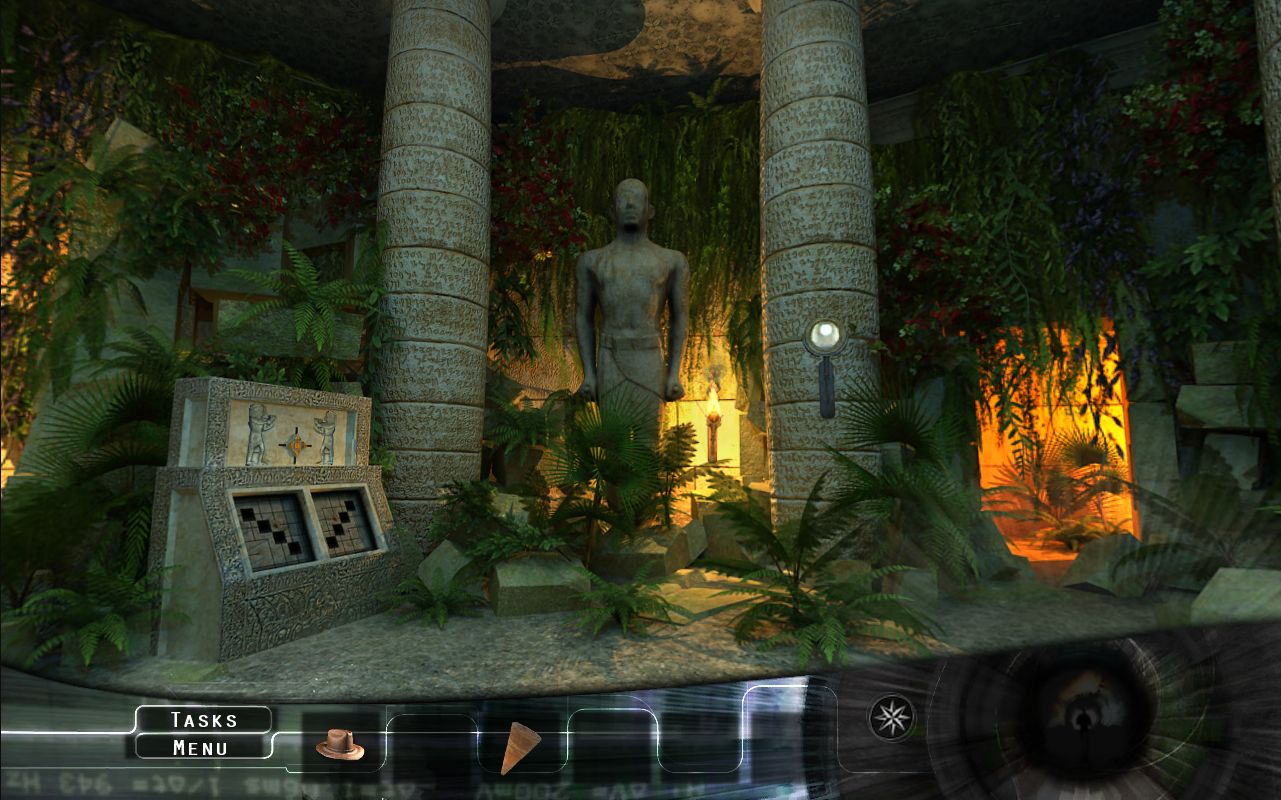
The story is rather vague in this first chapter. The story starts with the main character falling into some pit. He wakes up inside of an abandoned Asian ruin, with no memory of where his is or even who he is. He must then work his way out of the ruin solving puzzles at the many devices blocking his path. Along the way he occasionally has flashbacks of his prior life as he slowly regains his memory.

The puzzles of Separation are a mixture of hidden object and logic. They are mostly easy, even without using the hint systems, and very conventional; Solid, but without any of them really rising above the others as being particularly interesting. But one nice feature of the game is that the user will almost always have multiple puzzles to pick from at any time, giving the user some choice in his direction, even if the game is ultimately linear.
Probably the most refined feature of the game is the presentation. The environment is interesting and detailed; Containing many small animations that really bring it to life. Additionally, the interface is nice looking and very functional. One of the most notable aspects of the game is the soundtrack. The soundtrack is very upbeat and relaxing and also just very enjoyable music to listen to. And In addition, the sound effects and voice overs are very well done and only add to the experience. One notable option in the game is “360 Degree Free View”; This option enables or disables the free viewing of the rooms. When disabled all the rooms are separated into screens, when enabled the user is able to look around freely. There is no reason for this option to ever be turned off in my opinion, and it would significantly take away from the experience if it was.
Overall the game is enjoyable, but it is also somewhat bland. The Asian ruins are beautiful, but also dull and lifeless. It never really looks like a place that could exist, and as such does not draw you into the experience. The puzzles are also very conventional, every single one of them has been done before by other adventure games and done better.


Positives:
The plethora of good interesting puzzles.
Natives:
The lack of any real unique puzzles.
Summery:
A solid puzzle game, but it could benefit with a few unique puzzles.
Rating:
7/10
System Requirements:
OS: Windows XP, Vista
CPU: 800 MHz
RAM: 1280 MB
DirectX: 9.0
Hard Drive: 137 MB


