Showing posts with label puzzle. Show all posts

Tuesday, September 6, 2011

Limbo


Limbo is a very famous indie XBLA platformer that recently got ported to the PC, giving me and many others the ability to finally play it. At its core it is simply a platformer with some puzzles but what makes it great is its style.

It is wonderfully dark, and I am not just talking about the graphics. The giant spiders, zombie worms, murderous children, and effective traps are all fantastically realized and delightful cruel, made all the more poignant because you are playing as a child. And while the officially explained plot is minimalistic I think it is safe to say that it all takes place in a dream that he has after falling asleep in a forest.


Sunday, August 7, 2011

Two Bioluminescent Environmental Platformers

I just played two platforming games with blight colourful, luminescent, graphics and with environmental themed plots.

In CreaVures you play as group of specialist forest creatures in which you take control of any one at a time to traverse the forest to gather its fading light and save it. Its part action, part platforming, part puzzles, but mostly casual and atmospheric; The puzzles are very simple, the action is slow, and the platforming is not designed to be precise or fast (I recommend you don`t pay the Challenging difficulty as the controls and un-agility of your creavures are not quite up to it).


While in The Undergarden the gameplay is quite different: It is a mildly puzzle platforming take on Flower. In  the game you travel through a underwater cave system pollinating plants and using fruit to solve some very simple puzzles.


Friday, July 1, 2011

Puzzle Agent 2

With mysteries remaining in Scoggins, Minnesota detective Nelson Tethers just cannot get it out of his thoughts or the gnomes out of his nightmares, even if the case is officially considered solved. So taking vacation leave Tethers returns to Scoggins to finally bring the mystery of the forest gnomes and the missing people to a close.


Puzzle Agent 2 is most of all a sequel to Puzzle Agent, it has the same cartoony 2D hand drawn graphics, wacky plot, selection of mini-games, and starts off right where the first game ended. So if you enjoyed the first game you are likely to enjoy this one just as much but for anyone who has not played either of these games I will try to convince you in the following review.

Puzzle Agent 2, and more generally the entire series to date, is a very unique adventure/puzzle game. In addition to the normal conversation trees with NPCs and story progression there are numerous and diverse mini-games, which are the centrepiece of the entire game. There are optional puzzles and bonus puzzles, mathematical based puzzles and logical puzzles, hard puzzles and easy puzzles, as well as familiar puzzles and unknown puzzles, but all of them are at least somewhat enjoyable.


The graphics are interesting if nothing else. Quintessentially, cartoony and at least appearing to be hand drawn with minimalist jerky animation. They lend a unique visual style which is as essential as beauty, but I cannot say that they look great or even much better then good.

And equally as unique as the rest of the game, the plot of Puzzle Agent 2 is a direct sequel to Puzzle Agent. But where the first game has a freaky and strange plot already Puzzle Agent 2 takes this concept and runs with it, and it definitely keeps you on your toes. And like the graphics I cannot really say that is is a great plot; It serves to differentiate and give the Puzzle Agent world its own theme and mood, which is as important as anything else and it does make one enjoyable world.


Overall it is one of the more realistic fictional worlds. Everything just fits together, makes sense, and makes a finished product that is even better then the sum of its parts. The one bad part of the entire game is the length which, even while not using a single walkthrough or external hint, I was able to complete in under 4 hours, and I think 2 hours would be easily possible, for anyone who is not worrying about their score.

My mini-review of Puzzle Agent 2.


Wednesday, March 23, 2011

Portal and the Games it Inspired

In the lead-up to the release of Portal 2 in April of this year, and simply to celebrate a great game, I though it might be worthwhile to talk about the game that started this wonderful series and the games it inspired.


To start off, Portal is an incredibly fun 3D puzzle platformer with a dark sense of humour given by the artificial intelligence GlaDOS who continually tries to kill you. The puzzles are all some form of platforming while making use of the portal gun; A gun capable of created two portals that allow instantaneous transportation through space. The game also features a wonderful sound track and contains one of the obvious best songs in any OST, the credit song Still Alive.


Portal: The Flash Version is a 2D interpretation without any plot or dialogue, but with the benefit of being a far more challenging game. While it does not have the same humour as the original it is still a great game and I would recommend and fan of Portal or puzzles games to check it out.


The last game I want to talk about is called ASCIIpOrtal (aka ASCII Portal); It is a 2D ASCII graphics interpretation of Portal. It contains the original's humour as well as the puzzle platforming but this time around with more importance given to split second hand-eye coordination and challenge. The result is a deadly challenging game with tons of maps and a healthy fan made map community. The one strike against it is the controls. Since it uses normal typing control, to run you have to hold down the arrow key and wait a second for the key to start repeating. So you are really going to want to change your keyboard options to reduce this lag as much as possible and ramp up the repeat speed.


Mini-reviews of Portal games.

Friday, March 18, 2011

The Fall Trilogy: Chapter 1 – Separation

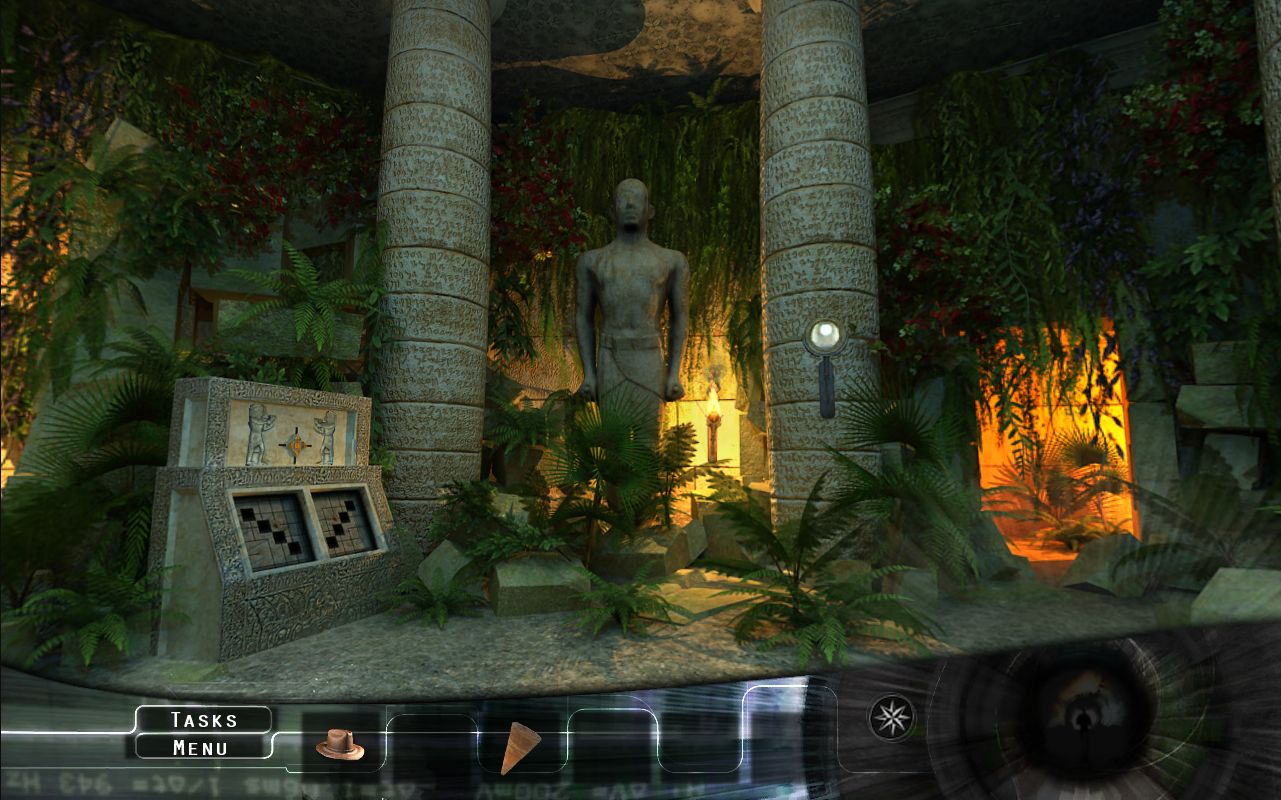
The first chapter of The Fall Trilogy, Separation, mixes the genres of puzzle, hidden object, and adventure. It is a release of Kheops Studios and is primarily a puzzle game, with some hidden object puzzles mixed in, and a small amount of story and inventory puzzles making up the adventure portion. It is a easy game, and even when a user gets stuck there are many options available to them to help solve the current problem. As such, it is great game for any newcomers to the adventure or puzzle genres; But still potentially holds a lot of entertainment for even the most hardcore fans of either.

One notable feature of Separation is the amount of hand-holding the game does; As the game takes the practice of giving hints to an extreme I have never before seen; Not that this is necessary a bad thing, as in general they are only offered and not pushed onto the player.

The map system for Separation

Some aspects of this hand-holding are build right into the gameplay, mainly the map system and the in-game commentary. The map system can be helpful as first it acts as a map, telling you where you have been and where you are, and secondly it notes what puzzles you have solved and which ones you have not. This mapping system even goes outside of the map screen into the game area; Where the game will note the name of the rooms you hover your mouse over if you have already been there, or a statement about not having explored that location, if you have not yet been there. All of this serves to make sure the user is never lost and always knows where he has to go. Like most adventure games, Separation has a few lines of dialogue whenever the user uses an item or clicks an interactive area on the screen. In Separation this commentary is often used to give subtle tips to the user when the incorrect solution is tried. These tips of course are given without the user asking for them, but they are subtle enough that they did not bother me.


The other aspects of the hand-holding are more conventional. One of these is built into the objectives menu; At any time the user can ask for a tip for any specified objective, but after the tip is used a short time is needed for the tip system to recharged before it can be used again. This same technique is mirrored in the hint system for the hidden object puzzles. And Instead of the hint system, normal puzzles simply have a skip function that charges in the same fashion. In addition to skipping the puzzles, stuck users have a few other options. One of them is the instruction system, that allows users to, at anytime, look-up how the current puzzle works. Puzzles are never explained, meaning this could be a useful feature; Except that all the puzzles are quite conventional and most players will have encountered all of them in one form or another many times before. And if this is not enough, the player can even reduce the difficulty of any puzzle he encounters, by simply resetting the puzzle and choosing the easy difficulty.

The story is rather vague in this first chapter. The story starts with the main character falling into some pit. He wakes up inside of an abandoned Asian ruin, with no memory of where his is or even who he is. He must then work his way out of the ruin solving puzzles at the many devices blocking his path. Along the way he occasionally has flashbacks of his prior life as he slowly regains his memory.


The puzzles of Separation are a mixture of hidden object and logic. They are mostly easy, even without using the hint systems, and very conventional; Solid, but without any of them really rising above the others as being particularly interesting. But one nice feature of the game is that the user will almost always have multiple puzzles to pick from at any time, giving the user some choice in his direction, even if the game is ultimately linear.

Probably the most refined feature of the game is the presentation. The environment is interesting and detailed; Containing many small animations that really bring it to life. Additionally, the interface is nice looking and very functional. One of the most notable aspects of the game is the soundtrack. The soundtrack is very upbeat and relaxing and also just very enjoyable music to listen to. And In addition, the sound effects and voice overs are very well done and only add to the experience. One notable option in the game is “360 Degree Free View”; This option enables or disables the free viewing of the rooms. When disabled all the rooms are separated into screens, when enabled the user is able to look around freely. There is no reason for this option to ever be turned off in my opinion, and it would significantly take away from the experience if it was.

Overall the game is enjoyable, but it is also somewhat bland. The Asian ruins are beautiful, but also dull and lifeless. It never really looks like a place that could exist, and as such does not draw you into the experience. The puzzles are also very conventional, every single one of them has been done before by other adventure games and done better.


Positives:
The plethora of good interesting puzzles.

Natives:
The lack of any real unique puzzles.

Summery:
A solid puzzle game, but it could benefit with a few unique puzzles.

Rating:
7/10

System Requirements:
OS: Windows XP, Vista
CPU: 800 MHz
RAM: 1280 MB
DirectX: 9.0
Hard Drive: 137 MB

Wednesday, March 16, 2011

Adam's Venture: The Search for the Lost Garden


Adam's Venture: The Search for the Lost Garden is the first episode in a new episodic 3D platforming exploration adventure game with some great visuals and a interesting story. In the game you play Adam, a archeologist in search of the Garden of Eden and a typical arrogant adventurer. 


The game really has some of the spirit of a point and click adventure, with some logic and inventory puzzles that would fit well within such a game. But unfortunately these puzzles are one of the least appealing aspects of the entire game. The “logic” puzzles, for example, are for the most part just the same puzzle over and over again; Which is simply finding the correct order of three sentences, a very quick thing to try all solutions for and you are given no hint to any possible order other then what would make logical and grammatical sense, so you very well might have to do this. The second main problem I had with the game is the emotion, or lack thereof, of the characters. In this area I just felt their was something missing right from the start, and particularly hated the way the protagonist takes off his hat to brush his hair with his hand. And even at platforming it is not particularly good, as I found the characters movements to be somewhat jerky and unreliable when jumping. Not that all of this does makes a huge difference, it is still a great looking exploration game.


Another topic I want to cover is the plot. It is a moderately interesting and based on Christian myths. But one thing that I do not think the game is is non-violent or that it teaches you Christian values. Sure, their are a few specific examples you could use for both of these, but I would say taking the game as a whole it does not hold true to either of these ideals. For non-violence their is a scene in the game with a gun and the imminent threat of death because of this and multiple ways for both you and others to die in the game, some sounding very gruesome. I also don't think their is any substance to any Christian values claim, but don't particularly want do some exhaustive analysis. Another topic that counts in my negatives for this game is the advertizing, I found it to be particularly unethical in its misleading and downright lying advertizements (which is only compounded by its Christian nature in my opinion).


Now I have said a lot of bad things about this game, but I did enjoy it and while their is a huge amount of room for improvement it is still a good unique title that I wish to see more games from. And the only real problem I have with it is how it seems it is being advertized, which more likely then not is in the publishers area of control (not that that is not a reasonable excuse not to buy a game).

Saturday, February 26, 2011

Stacking


Luckily I recently had a chance to do a lot of watching, back seat driving, and even a little playing of Stacking, the new game by Tim Schafer and Double Fine Productions for the PS3 and Xbox 360. It is a humorous 3D puzzle platformer that really lives up to Tim Schafer's reputation, and I believe that it is potentially just as good as any of his other masterpieces.

In the game you and the rest of the population are Russian stacking dolls that all have some special, often strange, abilities. You are the smallest doll, Charlie Blackmore, which you use to stack with any other doll, incrementally one size up at a time. When stacked with other dolls you control the top most doll, but you can unstack at any time to combine abilities or just to stack again with smaller dolls. This stacking mechanism is used to solve puzzles around the game world, which have some unique attributes themselves. Every puzzle in the game has multiple ways of solving it and instead of hiding how many different ways and only allowing you to do each puzzle once you are told exactly how many ways each puzzle can be solved and you progress in finding all the solutions is recorded, but solving it more then one way is never required. This can be really great for people who like to get 100% completion in games, and can add a lot of content and playtime.


The first thing that should hit you about this game is its graphics. The graphics are simply amazing and realistic; With all the dolls, and their are a lot of them, being very detailed and beautiful. The environment is also great and unique and is a  combination of steampunk and industrial age architecture and art.


But what really makes it seem like a Tim Schafer game is the story and the script. The storyline is presented like a silent film and concerns the Baron enslaving the Blackmore family and many other children and Charlie Blackmore's quest to free the children and his family. While this story is interesting my favourite part is the script of many of the smaller out of the way characters. These unnecessary conversations can be simply hilarious and one of my favorite parts of the game was simply stopping and watching a conversation between some unimportant characters. Also their is an attention to detail and a continuity and uniformity that really makes Tim Schafer's worlds come alive and seem real no matter how fantastical they are, which this game has in oodles.

Monday, December 13, 2010

Fetus

Fetus is a simple dark horror physics puzzle platformer. It has nice simplistic visuals, and an ever expanding arsenal of gameplay. While the visuals look perfectly dark and horrific, one thing that I think was missing was matching gameplay. For the most part it is hard to die and it is never in a gruesome way; But this is made up for in multiple other areas. For one the ending is very scary and lives up to the horror visuals. Additionally, the music is top notch and really adds to the experience. One of the more interesting parts of the game for me was that the game never explained anything and you had to figure it out through trial and error. For example, near the beginning of the game you pick up a follower, a ghost called bob. This ghost has a pretty interesting twist to it in my opinion, which is left up to player to figure out and I am not going to wreck the surprise. So while Fetus is not a great game it is a good game.

Edit: as of a few weeks latter I really have to say that Fetus has grown on me, it is a very memorable game that is well worth a play-through.