Showing posts with label 3D. Show all posts

Thursday, August 4, 2011

Half Life

Recently finished playing Half Life: Source, which is simply Half Life ported to the Source engine. It has the same levels, same graphics, same everything; Wrapped in a shiny new and theoretically better engine. It is simply a fantastic game with a wide range of entertaining experiences to offer. Playing the game I could not help but stop and think that they really don't make FPSs like they used to. There are elements of horror, action, tactics, and even a few puzzles.

It is simply an amazing game full of unique and enjoyable gameplay. On the the most acclaimed parts of this gameplay is the enemy AI; While the monsters act quite normally for games of that era the human squads act far more realistic then ever before seen. They will run away if losing and even have a habit of flanking you. Overall it is a simple system that seems to be based on damage ratio (do significantly more damage then you take, particularly in a short period of time, and you can cause the enemies to turn tail and run) which adds a significant amount of tactics and strategy to the game. Adding to this are remote controlled bombs, vicinity detonated mines, and turret emplacements and a plethora of unique weapons.

But above and beyond the AI and the action and shooting is what really makes the game. There is a ton of platforming, exploring, and even a few puzzle like challenges. The shooting as actually a minority of the gameplay, it is really the platforming and exploring that the game is about, i just wish that more developers understood that a FPS does not have to be all shooting and that anything done in enough repetition is boring.

My mini-review of Half Life.


Tuesday, August 2, 2011

Dead Cyborg

I had a chance to finally finish Dead Cyborg episode 1 a few days ago so I can finally give my full opinion on this game.


The graphics style is fantastic; The game world seamlessly blends the hard sci-fi, post-apocalyptic horror, and humour into a great cohesive whole; And the dialogue and story is terrific. It simply is one of the best worlds to emerge from the mind of a indie developer in recent history.

That is not to say it is perfect. I don't think that anyone would argue that the puzzles are (while possibly somewhat realistic) not very interesting. Some are just far to ambiguous and unintuitive, while others are so intuitive and literal you are left thinking you must be missing something. But these are also something that I think can easily be improved in latter episodes, the world is what really cannot be changed at this late a juncture and it is already fantastic.

But this great episodic adventure might just end here if the developer does not get any more donations. While the game is free, and the developer wants the rest of the series to remain free as well, he does require some minimum amount of donations before he invests even more of his time bringing us the rest of Dead Cyborg. So if you have not already, head on over to the official website and give Dead Cyborg a whirl and if you enjoyed it think about donating.

My Indie Elitist Article and my mini-review on Dead Cyborg Episode 1: The Beginning of the Death.


Thursday, July 14, 2011

Dead Cyborg Episode 1: The Beginning of the Death Released

A game I have been looking forward to quite a lot has finally been released. Dead Cyborg is a episodic, first person, fully 3D, text adventure inspired, post apocalyptic, pay if you like, graphical adventure. And earlier today episode 1: The Beginning of the Death was released.

It looks great, is very long for a free episodic adventure, but not sold on the puzzles yet. Have made it about half way through level 2 but am now completely stuck.

Review to follow as soon as I get unstuck, but in the meantime you can play the game yourself, which can be downloaded from its website, and even donate to the developer to help get episode 2 released (if you are so inclined).


Thursday, July 7, 2011

Bulletstorm

Bulletstorm is the latest release from the esteemed studio of People Can Fly, and like the rest of their games it is a over the top shooter, and in this case one of the first person variety. It has gotten moderately good reviews overall and I agree with them in general. It is a fun game, but I have played FPSs with better core mechanics.

The first issue I want to tackle is a problem that this game shares with many recent FPSs and other combat focused genres. Bulletstorm, even on very hard difficulty (the hardest difficulty setting), is only moderately challenging. And I am not even a FPS person, so I feel bad for all the veteran FPS players out there, you just cannot seem to find a FPS that should not be played on the hardest setting the first time through any more. All in all it was not a bad difficulty to play on, but if I wanted to replay the game it would certainty be far too easy now to be worth it.


Additionally, I found the difficulty to be very inconsistent. For one the most hyped up, supposedly uber powerful, enemy in the game, the Burnouts. These enemies have giant soft spots all over their bodies in the form of puss filled cysts which act as instant kill (or head-shot) locations if given a small amount of damage; These enemies are also not quick, have no long range attack, and have absolutely no special abilities in other words they are a joke, and yet the game warns you about these end game super enemies more then any other. And the bosses and to an extent the mini-bosses make these Burnouts look like Rambo in comparison. The first boss is by far the best one, and the only one I would consider an actual boss, with multiple phases and tones of HP; The others are all clones of themselves, fight identically, only have one phase, and can be killed almost instantly. But there is one thing that all of these bosses have in common, it is near impossible for them to even hit you, let alone kill you (and even though I was playing the game for the first time on the hardest difficulty I still was never even close to hurt by any of them).


Not that the game is bad by any means, it simply is not as dedicated to this sort of finesse stuff. Instead Bulletstorm focuses on over the top, macho, and run and gun gameplay. For this you have the ability to kick objects and people and send them flying across the map; Leash them and send them flying towards you; Or doing a sliding kick which sends you sliding across the ground and kicks anything or anyone you come into contact with. Add to this the strategically placed explosive barrels, spikes, and pits and you get some pretty creative ways of killing people. And even the guns are styled in such a way to promote this run and gun style. For example, the sniper rifle goes into a slow-mo time when shot and actually allows you to aim and move the bullet as it travels to such an extent as to go around corners and over barriers to reach the target.

But probably the most unique aspect of the game is the skill point system. As you play you are awarded points as you kill people and the more creative you are the more points you get. It is basically a FPS version of Madworld. Except that I found it annoying to keep having to look up and memorise special combos and change guns simply to get the other gun specific ones. Additionally, more points then just playing like normal were not needed. Points are used to purchase gun upgrades and ammo. The ammo is at least moderately useful, but the upgrades also include additional storage space for ammo and both the ammo for and additional storage spots for charged shots, which are super powerful single shot attacks; Which are useful in some situations, but are too slow for the average firefight.


So it is a fun game but it hardly seems polished. Worth checking out if a less sophisticated FPS sounds appealing to you but it is hard to compare to the many well balanced titles out there.

My mini-review of Bulletstorm.

Sunday, June 5, 2011

Ace of Spades

Ace of Spades is a new free to play multiplier only FPS. Right now it is only in beta but the lack of features is actually quite refreshing.

The basic premise is a FPS in a complete sandbox environment made of Minecraft style blocks. These blocks can be added and removed with  relative ease allowing you to create buildings and fortifications while at the same time you and your team must protect your intel (flag) from the enemy team and try to steal their intel as well.

At this point, beta .51, you are equipped with a simple offensive load-out; You have your trusty bolt action rifle and some grenades. The biggest issue I have with the game is that while the combat with these weapons is fun, it is mostly useless as only capturing the lintel matters and enemies re-spawn almost instantly. In fact I have never seen an example of intel ever being captured under regular circumstances, and it basically is impossible, as far as I can tell, if both teams have a moderate amount of members and no one is cheating.

Still the game can be an interesting diversion and only promises to get better, so if you want to check it out go to ace-spades.com (note: it is a download game but you start a game by clicking on one of the active servers in the list on the webpage, I recommend aloha uswest pinpoint).

It is not a particularly photogenic game, but pictures can be seen at the official Ace of Spades Gallery.

Wednesday, March 30, 2011

Mount and Blade

To me Mount and Blade is on a completely different level then most games. It is one of those very unique, and yet still fun games, in league with the more famous Minecraft or (at least to me) the less famous Hammerfight. A truly great game but also one with a lot of room for improvements.


What makes this particular game unique and worth looking into is its combination of personal combat vs. groups of enemies, most notably featuring combat on horses, and the basic tactical control of the troops under your command. The personal combat, while slightly simplistic, is very fun and full of content; You can learn to use a bow, crossbow, spears/pikes/lances, one/two handed swords, maces, and shields, all in many different shapes and sizes. When fighting you have five weapon slots (which must also fit your arrows and bolts), so you have enough room for at least a few weapons. One thing to note is that, at least for pve, the speed of the weapon is far more important then the strength of the weapon because at high levels your internal stats will boost the power to instant kill for most troops anyways. And in combat the movement of your character significantly effects the damage dealt by your strikes, because weapon momentum is a factor in the calculation.


So lets talk a little about the weapons, their strengths and weaknesses and why you might want to use one or the other. The bow far outclasses the crossbow in speed of shooting and mobility while reloading, but is outdone in shear power and distance; And their is also thrown weapons, like knives and javelins, which do not seem to have very much range so I have never bothered with them, but the bonus of saving a equipment slot is nice; When I play I like to devote quite a lot of time and skill points to the bow simply because long range is useful in many situations like avoiding damage in drawn out battles and picking off fast horse opponents. The spears and pikes are particularly interesting weapons in that they are very reliant on momentum, so while they are completely uselessness if you are backing up or right next to enemies, while on a horse they are devastating, but still slow; Their main advantage is their incredible length and power when you are moving fast, and because of this they are the best weapon to use in some situations (meanly verses heavily armoured opponents while on a horse), but because of their slow speed I normally do not bother with them. The one handed weapons, particularly swords, are in my opinion the best general weapon that can be used well in any situation and are still the best possible weapon in many situations; The one handed weapon is fast, allowing you to slaughter quickly, and because it can be paired with a shield offers you a very good defence. Not that the two handed weapons do not have their own uses, I find they can be very useful for defensive situations, because of their long reach.


But even more important then the weapons you will be using is your horse. Your horse allows far improved mobility, speed (to add damage to your weapon strikes), and will even allow you to plough through enemies knocking them over. The horse, like any equipment, comes in many different variants and levels that offer a wide range of abilities. The only complaint I have concerning the horse is its use; Particularly, that it is never used in siege situations and always used in all other battles. I would love to see horses in sieges, sallying forth when the enemy least suspects it, or charging up a siege tower into the enemy defences. And the addition of battle terrain that hampers cavalry (dense forest) or makes them completely unusable (rocky terrain) would be an amazing strategic point and also a fun change.


Battles, as mentioned earlier, are basically you and your army verses another force. While they are hugely fun the one issue I have is the importance of yourself and the lack of strategy. Because of your overwhelming power your character will have only a few hours into the game, the lack of an effective troop moral system in battles, and the small amount of control you have over your troops their is really only one strategy, charge at, and kill as fast as possible, the enemies (mostly ignoring your own troops). This sometimes reaches ridiculous levels like singularly defending a castle against hundreds of enemies by standing on the one entrance ladder into the castle and killing them all personally. What I would love to see is whole groups of enemies running away after particularly successful strategies, instead of the few individuals that were seconds away from death anyways; The ability to set up devastating formations like creating a tight cavalry wedge to smash through a enemy line; And improved AI with the choice to change the strategy of individual troops, so it is not just run towards enemies and hope it does not end up alone and surrounded by them. (Now I don't want it to seem that I am just mindlessly saying that the developers should implement some complex AI system, I have studied AI and have thought about it with respect to Mount and Blade quite a lot and am certain that even a programmer of as little experience as me could easily throw together everything I have mentioned here [and much more] in a short time period).


When not in battles you travel around on a real time Risk-like map, where you travel around looking for battles, trading, or simply travelling to cities or villages to restock, pillage, collect taxes, do some sort of quest, capture it, or recruit people for your army. All of this is done quite well and only really gets annoying late in the game when large armies will get demoralized so easily you will lose troops at an amazing rate and your companions squabbling will reach levels that also have them streaming from your party. Additionally, I have encounters a lot of annoying problems when running a big kingdom. For example even though you will need lots of money to keep a presence in all of your cities tons or money is lost simply because you own a lot of land and if you awarding land to a lord then all other lords get pissed at you that they were not picked, so if you have many lords then overall awarding land to one of them can leave you in the deficit. So basically the game has no end-game, it simply become unplayable.

My mini-reviews of Mount and Blade and Mount and Blade: Warband.
The Mount and Blade website.

Sunday, March 27, 2011

Walkthrough: I Was a Vegas Showgirl

Since I personally had a little trouble getting through I Was a Vegas Showgirl!, could not find any help online, and have never done a walkthrough so I thought it might be fun to do one.

My mini-review of  I Was a Vegas Showgirl!


Controls:
Space - select, use, talk to
E - skip dialogue, examine
Enter - open Inventory, put away item
Esc - Options


Walkthrough:
Opening cutscene ending with you outside Stack-O-Lee's Casino Cabaret.

  • Talk to the Olivetti and learn that The Bouncer has taken his camera.
    • Dialogue Tree: Are you a reporter? -- Why'd he take your camera -- Enough about the camera... -- Goodbye, Mr.
  • Talk to The Bouncer to learn how to get to Stack-O-Lee and get Olivetti's camera back.
    • Dialogue Tree: Can I see Mr. Stack-O-Lee? -- I'm a top showgirl -- Do you have that guy's Camera? -- ... he won't stop crying.
  • Give camera back to Olivetti, learn that it needs a new flash.
  • Enter Casino through front door.
  • Take Floodlight (upper left of screen).
  • Exit Casino.
  • Give Floodlight to Olivetti and get Photo of yourself.
  • Walk to right side of Casino (walk right and up), with back Stage Door.
  • Enter Stage Door, and emerge again automatically outside.
  • Walk back to front of Casino (up and left) and then enter Casino.
  • Talk to Drunk to learn about how to dance.
    • Dialog Tree: Why didn't you like my routine? -- Do the Goggle-eyes. -- Do the Dance Macabre -- Do the Crazy Chicken -- Do the Choo-choo -- Do the ol' Bob and Weave.
  • Exit Casino and then go to right side of Casino and enter the Stage Door.
    •  Dialog Tree: Do the Dance Macabre -- Do the Goggle-eyes. --  Do the ol' Bob and Weave. -- Do the Crazy Chicken -- Do the Choo-choo.
  • Back outside the Stage Door walk to front of Casino.
  • Talk to The Bouncer to convince him you are a hit.
    • Dialog Tree: I'm a hit?
  • Give Photo to The Bouncer.
cutscene ending with you inside of Stack-o-Lee's personal suite talking to him.

    • Dialog Tree: May I have a highball?
  • Examine Turntable.
  • Talk to Stack-o-Lee to drink.
  • Talk to Stack-o-Lee again to get him to turn on the music.
    • Dialog Tree: How about some music?
  • Use Panel (down and to the left), talk to entrance, and get Olivetti sent up.
    • Dialog Tree: Press Button 6: Entrance -- Send that reporter up here. -- Don't make me say it twice!

End cutscene and credits.


Losing Endings:
  1. Try to slip drugs into Stack-o-Lee's drink while making him one.
  2. Talk to Black Jack and get Billy Lyons sent up.

Friday, March 18, 2011

The Fall Trilogy: Chapter 1 – Separation

The first chapter of The Fall Trilogy, Separation, mixes the genres of puzzle, hidden object, and adventure. It is a release of Kheops Studios and is primarily a puzzle game, with some hidden object puzzles mixed in, and a small amount of story and inventory puzzles making up the adventure portion. It is a easy game, and even when a user gets stuck there are many options available to them to help solve the current problem. As such, it is great game for any newcomers to the adventure or puzzle genres; But still potentially holds a lot of entertainment for even the most hardcore fans of either.

One notable feature of Separation is the amount of hand-holding the game does; As the game takes the practice of giving hints to an extreme I have never before seen; Not that this is necessary a bad thing, as in general they are only offered and not pushed onto the player.

The map system for Separation

Some aspects of this hand-holding are build right into the gameplay, mainly the map system and the in-game commentary. The map system can be helpful as first it acts as a map, telling you where you have been and where you are, and secondly it notes what puzzles you have solved and which ones you have not. This mapping system even goes outside of the map screen into the game area; Where the game will note the name of the rooms you hover your mouse over if you have already been there, or a statement about not having explored that location, if you have not yet been there. All of this serves to make sure the user is never lost and always knows where he has to go. Like most adventure games, Separation has a few lines of dialogue whenever the user uses an item or clicks an interactive area on the screen. In Separation this commentary is often used to give subtle tips to the user when the incorrect solution is tried. These tips of course are given without the user asking for them, but they are subtle enough that they did not bother me.


The other aspects of the hand-holding are more conventional. One of these is built into the objectives menu; At any time the user can ask for a tip for any specified objective, but after the tip is used a short time is needed for the tip system to recharged before it can be used again. This same technique is mirrored in the hint system for the hidden object puzzles. And Instead of the hint system, normal puzzles simply have a skip function that charges in the same fashion. In addition to skipping the puzzles, stuck users have a few other options. One of them is the instruction system, that allows users to, at anytime, look-up how the current puzzle works. Puzzles are never explained, meaning this could be a useful feature; Except that all the puzzles are quite conventional and most players will have encountered all of them in one form or another many times before. And if this is not enough, the player can even reduce the difficulty of any puzzle he encounters, by simply resetting the puzzle and choosing the easy difficulty.

The story is rather vague in this first chapter. The story starts with the main character falling into some pit. He wakes up inside of an abandoned Asian ruin, with no memory of where his is or even who he is. He must then work his way out of the ruin solving puzzles at the many devices blocking his path. Along the way he occasionally has flashbacks of his prior life as he slowly regains his memory.


The puzzles of Separation are a mixture of hidden object and logic. They are mostly easy, even without using the hint systems, and very conventional; Solid, but without any of them really rising above the others as being particularly interesting. But one nice feature of the game is that the user will almost always have multiple puzzles to pick from at any time, giving the user some choice in his direction, even if the game is ultimately linear.

Probably the most refined feature of the game is the presentation. The environment is interesting and detailed; Containing many small animations that really bring it to life. Additionally, the interface is nice looking and very functional. One of the most notable aspects of the game is the soundtrack. The soundtrack is very upbeat and relaxing and also just very enjoyable music to listen to. And In addition, the sound effects and voice overs are very well done and only add to the experience. One notable option in the game is “360 Degree Free View”; This option enables or disables the free viewing of the rooms. When disabled all the rooms are separated into screens, when enabled the user is able to look around freely. There is no reason for this option to ever be turned off in my opinion, and it would significantly take away from the experience if it was.

Overall the game is enjoyable, but it is also somewhat bland. The Asian ruins are beautiful, but also dull and lifeless. It never really looks like a place that could exist, and as such does not draw you into the experience. The puzzles are also very conventional, every single one of them has been done before by other adventure games and done better.


Positives:
The plethora of good interesting puzzles.

Natives:
The lack of any real unique puzzles.

Summery:
A solid puzzle game, but it could benefit with a few unique puzzles.

Rating:
7/10

System Requirements:
OS: Windows XP, Vista
CPU: 800 MHz
RAM: 1280 MB
DirectX: 9.0
Hard Drive: 137 MB

Wednesday, March 16, 2011

Why I Play Minecraft

Their have been numerous Minecraft reviews that rightly give it acclaim for its many different features and its many different gameplay types. So while I personally really like Minecraft I did not see any reason to add one more review that would say nothing new. Fortunately, one of the more acclaimed features of Minecraft is the multiple ways/reasons to play it, so the following will be my attempt to review and explain the reason I play Minecraft.

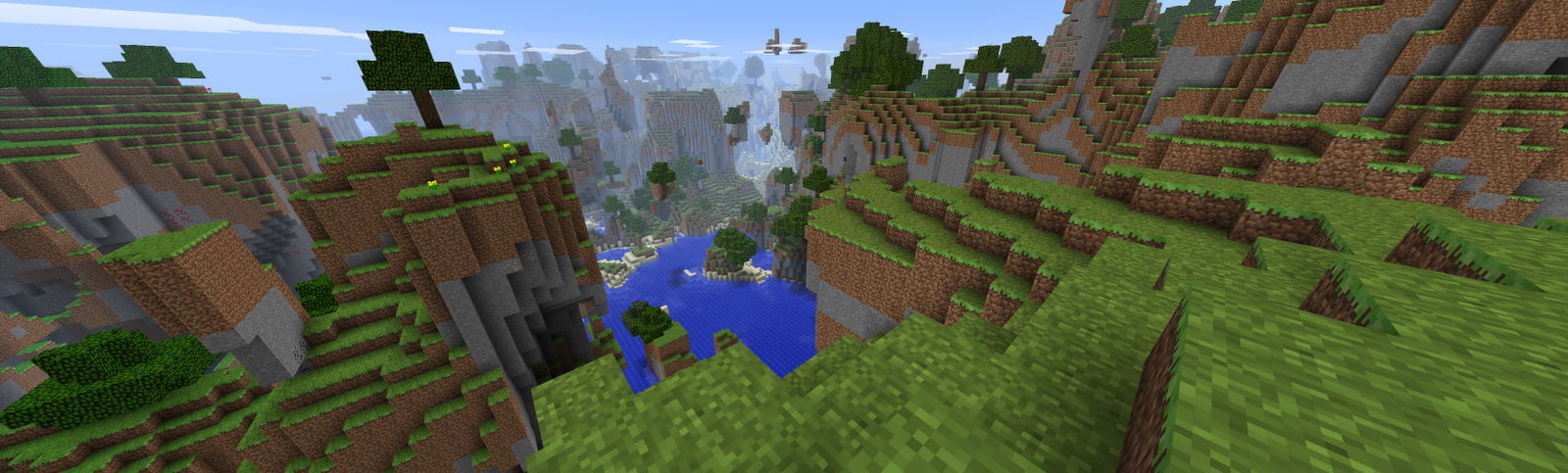
In a sentence, I play Minecraft for the exploration and the fantastic visuals. I find while playing I tend to look towards the horizon, down a pit, or towards a cave and want to go their, to see what is there and experience what their is to experience there; Maybe climb a mountain side to look down on the surrounding environs or ride a waterfall down into the deep recesses of the earth to encounter monsters and lava flows. And what fantastic visuals, while they are somewhat simplistic close up, at a distance they ride a thin line between pixelistic and realistic where, I find, their is room for some imagination but it still looks amazing and real in its own right.

To showcase my point I will include some pictures from Minecraft with Terrain Mod installed and with many different settings. Click to enlarge.


Awe inspiring, isn't it?